India, like many countries around the world, continues to grapple with the question of legalizing same-sex marriage. While same-sex sexual activity was decriminalized in 2018 with the landmark Supreme Court decision in Navtej Singh Johar v. Union of India, same-sex marriage remains unrecognized by Indian law. India is yet to legalize same-sex marriage, despite the decriminalization of same-sex sexual activity in 2018 (Navtej Singh Johar v. Union of India, 2018). There are cultural, religious, and social norm-related challenges in recognizing same-sex marriage. However, there are also several compelling reasons, supported by empirical data, for why India should consider legalizing same-sex marriage. These include adoption of hard-to-place children (Gates & Badgett, 2006), promoting social inclusion and reducing discrimination (Mohapatra, 2021), improving mental health outcomes (Hatzenbuehler, 2009), reducing HIV/AIDS transmission (Poteat, 2019), promoting economic benefits (Badget...
Today, I really am going to bring light over a severe topic which always got denied and neglected by the whole society from a long period of time. The foreheads of the vast majority of religious, traditional, fundamentalist, believers, moral brothers and sisters, in the society will be frowned upon by this topic. It's nothing other than "Homosexuality". Initially they start by asking interviewees that, what and is homosexuality okay? The interviewees including students and teachers intellectually and liberally support the act of same-sex relationships by adding points of it being Genetic, Biological, Consensual and natural. As a cross argument, they asked them - If genetic was premise, what about serial killer genes (MaOA gene), being natural was premise, what about rapes happens in dolphins and if being consenting was premise, what about having consensual incest relationships? Popular religious institutions like Christianity, Islam,...
Human sexuality is a complex and multifaceted phenomenon, shaped by a wide range of biological, social, and cultural factors. While the majority of people are heterosexual, a significant minority identify as homosexual, with estimates suggesting that between 2-10% of people may be gay or lesbian (7). The existence of homosexuality has long puzzled scientists, as it appears to contradict the principles of natural selection and the idea that only traits that confer a reproductive advantage will survive over time. However, recent research suggests that the evolutionary basis of homosexuality is more complex than previously thought, with biological, social, and cultural factors all playing a role in shaping sexual orientation. In recent years, there has been a significant increase in research on the genetic and hormonal factors that may contribute to the development of homosexuality. For example, a large-scale genome-wide association study (GWAS) conducted in 20...
Many of you may have misconceptions and doubts when you hear about sex, gender and sexuality. Both materialists and superstitious people in general unleash discrimination against individuals belonging to these groups by making a number of vague and irrational arguments in order to maintain their beliefs and traditions.
But it is important to understand the difference between gender, gender, and one's sexuality. This is because our society is always presented inappropriately, which increases the misinformation and misconceptions about these communities. The vast majority of our society does not accept or are willing to accept the fact that sex, gender and one's sexuality are not the same. Some deliberately portray it as a pseudoscience, even though these are theorized by leading scientific researchers and scientific organizations.
Let's analyze what does majority of researchers and scientific health research organizations say about it.
Gender refers to the attitudes, feelings, and behaviors that a given culture associates with a person’s biological sex (APA, 2012). Gender is a social construct and a social identity. Use the term “gender” when referring to people as social groups. [1] Gender identity is a component of gender that describes a person’s psychological sense of their gender. Many people describe gender identity as a deeply felt, inherent sense of being a boy, a man, or male; a girl, a woman, or female; or a nonbinary gender (e.g., genderqueer, gender-nonconforming, gender-neutral, agender, gender-fluid) that may or may not correspond to a person’s sex assigned at birth, presumed gender based on sex assignment, or primary or secondary sex characteristics (APA, 2015a). Gender identity applies to all individuals and is not a characteristic only of transgender or gender-nonconforming individuals. Gender identity is distinct from sexual orientation; thus, the two must not be conflated (e.g., a gay transgender man has a masculine gender identity and a gay sexual orientation, a straight cisgender woman has a feminine gender identity and a straight sexual orientation). [2]
The term gender differences generally applies to sexual dimorphisms, which are thought to have evolved as a result of sexual choice. For example, the "gender difference" of a tall man is a consequence of sexual choice, while the "gender difference" is not usually found in the length of hair (women with long hair). Scientific research shows that a person's sexuality influences his or her behavior.
Biology of Sex, Gender and Sexuality
Before we know where these expressions come from. We need to understand it's biology, social and genetic aspects. If we describe sexuality in simple terms, it refers to one's biological sex, that is either male, female or intersex. Sex is usually determined at birth by the baby's chromosomes, gonads, and body composition. These are the main three features used to determine biological sex of a person.
Chromosomes - These are tiny structures in the cells that house your unique DNA. A pair of chromosomes called the sex chromosomes determines whether you are male or female. Females have two X chromosomes, and males have an X and Y chromosome.
Gonads - These are the primary reproductive organs. Males have testes and females have ovaries there are incidents where one posses both testicular and ovular tissues (ovotestis). These organs also secrete hormones that promote reproduction.
Anatomy - Physical genitalia determine sex during the baby’s development. Genitals are the first of the characteristics that determine sex to develop in the womb. Genitalia are the primary sex characteristic, but secondary characteristics are considered, such as breasts, frame, and facial hair.
Three type of Sex
The above parameters are not definitive. There can be slight variations along the way that will make a sex label inaccurate. Medically, there are three possible sexes assigned at birth: female, intersex, and male.
Lets check out the basic characteristics of these sexes. Scroll left to explore 3 sexes:
Because of the possibility for variations, "intersex" has become an umbrella term for a wide variety of people. This makes it clear that sex isn’t black and white.
The human body possess 46+XY Chromosomes or with fully developed pair of testes (male gonads) are considered as male and the human body possess 46+XX Chromosomes or with fully developed pair of overies (female gonads) are considered as female. Where human body possess 46+(XX/XY or XXX/XXY or any other sort of chromosomal conjugations) or with underdeveloped or half developed or with both female and male gonads are likely to be called as intersex or hermaphrodite.
As we all know for the first 6 weeks the sex of the embryo remains undifferentiated, but phenotypically female. After 6 weeks, Y chromosome and SRY Gene comes into the scene and the variation of testosterone and estrogen hormones and other neurotransmitters in the womb decides the sexuality or masculinisation and feminisation of the foetus. Embryos fused with Y chromosomes masculinise or lead to develop testacles otherwise ovaries, in rare situations unusual amount of sex hormones or Congenital adrenal hyperplasia or Aromatase deficiency leads to development of mixed or combined or rare gonads are commonly known as intersex conditions.
There are mainly 4 types of intersex,
46+XX intersex
46+XY intersex
True gonadal intersex
Complex or undetermined intersex.
- The person has the ovaries of a woman, but external (outside) genitals that appear male, Fused labia and clitoris enlarges to appear like a penis is the common feature of the 46+XX intersex. Where, the person has the chromosomes of a man, but the external genitals are incompletely formed, ambiguous, or clearly female. Internally, testes may be normal, malformed, or absent is the common feature of 46+XY intersex condition. These are called pseudo-hermaphrodism in humans.
- But sometimes, The person must have both ovarian and testicular tissue. This may be in the same gonad (an ovotestis), or the person might have 1 ovary and 1 testis. The person may have XX chromosomes, XY chromosomes, or both. The external genitals may be ambiguous or may appear to be female or male. This condition used to be called true hermaphroditism.
Some intersex identities are able to reproduce and some are not, sometimes initially they was subjected to surgery.
Read "Intersex Explained" for an elaboration of over the biological, genetical and social aspects. There we have explained what, how and when this happens
Why Sex Isn’t Sexuality?
It’s easy to get lost in the weeds when discussing sex and gender. It becomes more complex when sexuality is dropped in. But it doesn’t need to be. Sexuality is basically your sexual orientation. It roams between mainly three elements:
who you’re attracted to
your sexual behaviors
your identity
Like most things, descriptions of sexuality are so large that they cannot be contained in a simple binary. Sexuality takes into account your sex or gender and the sex or gender of any partner. It is important to know that your sex does not predetermine your sexuality. Your sexual behaviors, who you’re attracted to, relationships, and personal identity, influenced by societal norms, and social stigmas, are the forces behind your sexuality.
Some of the identifiers for sexuality (or sexual orientation) include:
Gay (⚣)- Male(XY) romantically, emotionally and sexually attracted to another Male(XY)
Lesbian (⚢)- Female(XX) romantically, emotionally and sexually attracted to another Female(XX)
Straight - Person romantically, emotionally and sexually attracted to opposite gender.
Queer - Person who doesn't want to label themselves, its an umbrella term.
Bisexual - Person romantically, emotionally and sexually attracted to both Female(XX) or Male(XY).
Pansexual - Person romantically, emotionally and sexually attracted to all genders and sexes.
What Is Gender then?
Gender is a multi-faceted social system. Gender is largely based on society and culture. There are some consistencies, but it can be concluded that gender is not predetermined based on sex.
Gender refers to the socially constructed roles, behaviours, expressions and identities of girls, women, boys, men, and gender diverse people. It influences how people perceive themselves and each other, how they act and interact, and the distribution of power and resources in society. Gender identity is not confined to a binary (girl/woman, boy/man) nor is it static; it exists along a continuum and can change over time. There is considerable diversity in how individuals and groups understand, experience and express gender through the roles they take on, the expectations placed on them, relations with others and the complex ways that gender is institutionalized in society.
It is how they identify internally and how they express this externally. People may use clothing, appearances, and behaviors to express the gender that they identify with. However, gender is not neatly divided along the binary lines of “man” and “woman.”
Gender is more like a spectrum, from masculine to feminine. This includes every single gender identities.
Cisgender, Non-binary, Agender, Transgender, Androgyne, Bigender, Butch, Gender expansive, Gender Fluid, Gender Outlow, Gender Queer, Masculine of center, Omnigender, Poly - Pangender, 2 spirit etc are the prominent genders identified and reported widely across the world.
Gender roles - The backdrop of a discussion about gender is gender roles and gender assumptions. There are certain traits and roles that society expects people of each gender to fit into. Each culture has different gender roles. Gender identity and expression are derived from ideas about which traits and roles are perceived as masculine or feminine in that culture.
Gender identity - Arguably, the most important determinant of gender is your gender identity. This is the internal sense of self that states your gender, regardless of the sex assigned at birth. Some of the common gender identities are man, woman, nonbinary, and genderqueer.
Cis or cisgender - The terms “cis” and “cisgender” are used to describe a person whose gender identity aligns with the assumptions their culture makes about members of their sex. A person who is assigned a female at birth and identifies as female is considered cis.
Trans or transgender - A trans person’s gender identity doesn’t match the assumed characteristics of their assigned sex. A person who was assigned male at birth might feel that their identity and sense of self are aligned more closely with a female identity.
Nonbinary - A person who identifies as nonbinary feels that their gender identity doesn’t align within the male/female division. "Nonbinary" is an umbrella term that represents a variety of people. There is no single nonbinary gender identity.
Gender expression - This is how you express your gender identity. Gender expression (or gender presentation) is a combination of clothing, physical appearance, behavior, and mannerisms that convey your gender identity. Gender expression may be described as masculine, feminine, androgynous, or something else entirely. Gender expression will mean something different for every person. Not everyone will have the same perceptions, definitions, or identifiers.
These genders can be explained as :
Agender - A person who is agender does not identify with any particular gender, or they may have no gender at all. (Other terms for this may include: neutral, gender, null-gender, genderless, neutrois)
Androgyne - A person who identifies as androgyne has a gender that is either both masculine and feminine or between masculine and feminine.
Bigender - A person who identifies as bigender has two genders. People who are bigender often display cultural masculine and feminine roles.
Butch - Women, especially lesbians, tend to use this term to describe the way they express masculinity, or what society defines as masculinity.
Cisgender - A cisgender person identifies with the sex that they were assigned at birth. For example, a cisgender woman is someone who still identifies with the sex — female, in this case — a doctor assigned them at birth.
Gender expansive - The individuals who broaden their own culture’s commonly held definitions of gender, including expectations for its expression, identities, roles, and/or other perceived gender norms. Those who are gender expansive include people who are transgender and people whose gender broadens the surrounding society’s notion of what gender is.
Genderfluid - A person who identifies as genderfluid has a gender identity and presentation that shifts between, or shifts outside of, society’s expectations of gender.
Gender outlaw - A person who identifies as a gender outlaw refuses to allow society’s definition of “male” or “female” to define them.
Genderqueer - A person who identifies as genderqueer has a gender identity or expression that is not the same as society’s expectations for their assigned sex or assumed gender. Genderqueer can also refer to a person who identifies outside of how society defines gender or someone who identifies with a combination of genders.
Masculine of center - A person who uses this term is usually a lesbian or a trans person who leans more toward masculine performances and experiences of gender.
Nonbinary - A person who identifies as nonbinary does not experience gender within the gender binary.People who are nonbinary may also experience overlap with different gender expressions, such as being gender non-conforming.
Omnigender - A person who identifies as omnigender experiences and possesses all genders.
Polygender and pangender - People who identify as polygender or pangender experience and display parts of multiple genders.
Transgender - This is an umbrella term that encompasses all people who experience and identify with a different gender than that which their assigned sex at birth would suggest.
Trans - Trans is a more inclusive term that covers those who identify as nonbinary and those who are genderless,
Two Spirit - Two Spirit is an umbrella term that encompasses different sexualities and genders in Indigenous Native American communities.
Why are these that complicated?
I really don't think it's that complicated, because we are societies that make it a lot more complicated than we think it is.
These are terminology that are only used to indicate or label what one's inner and outer feelings and biology are. If you use any other terminology to address people belonging to these sexual minorities, they may take it as a verbal offense. As a responsible society, we need to live with each other with mutual respect and equal opportunities.
This is beyond the current scientific understanding. However, science recognizes that it is caused by a complex interplay of genetic, hormonal and environmental influences and does not see it as a choice. It has limitations in presenting it as a scientific fact, as it has yet to find a gene that controls one's sexual orientation. Numerous studies have proved that gender, sex and sexuality are different. But most of those studies have sample size limitations that make it difficult for researchers to understand and theorize. Even after that, they said that human sexuality is something that is unimaginably complex in nature, even though they could not find a single gene because it can be controlled by multiple or overlapping genes that are very difficult to study.
What we need to understand from these are, we all are having limited knowledge on human sexuality because it is complicated. But it does not make sense to interfere with one's personal preferences whether it is biological, genetic, or hormonal. Anything we all need a healthy mind and body, so focus on the things that make your mental health better than it usual are.
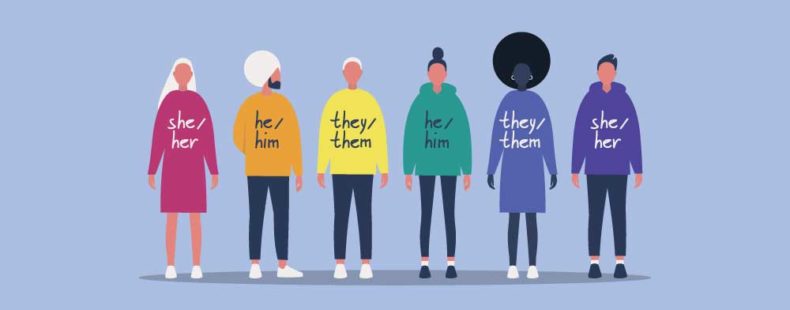
Why do gender pronouns matter?
Words are powerful language tools that help us to communicate and connect meaning. We use words to connect, differentiate, and describe everything around us. It may not be more personal than the names people use to refer to us by our names and pronouns.
It is imperative that workplaces become accustomed to these facts. More and more people are getting language and support to identify something other than the gender at birth, and then turn to staff who have the ability to identify them as transgender or non-transgender. For example, recent research shows that:
Millennials are twice as likely to identify as LGBTQ (20 percent) than in previous generations.
Fifty-six percent of respondents to Generation Z, a very different generation in the US, know someone who uses neutral gender pronouns — a significant increase from previous generations.
Employees now have more opportunities to deal with gender identity and speech in the workplace. Most transgender people do not refer to themselves on a binary scale - when identifying a man or a woman - and others like "sex", "sex liquid", "binary" or other words. These extended sexual characteristics are often considered part of a larger transgender society.
Things which should be taken care of while using pronouns:
The use of pronouns requires clarity and care on the part of the author. Do not refer to pronouns that are used by transgender and transgender people as “preferred pronouns” because this means a choice about one's gender. Use words like “identified pronouns,” “self-identifying pronouns,” or “pronouns” instead. When writing about a well-known person, use specific pronouns for that person. Some people use “they” as a noun; others use other pronouns such as “ze,” “xe,” “hir,” “per,” “ve,” “ey,” and “hen” (Swedish pronoun), among others. Some people may alternate between “he” and “he” or between “he and / or she” and “them,” while others do not use pronouns at all and use their own words instead of pronouns. Refer to a transgender person who uses gender-appropriate language, regardless of gender assigned at birth — for example, use the pronouns “he,” “she,” and “her” to refer to the transgender man who indicates the use of these pronouns.
When referring to people whose names are anonymous or where the sex of a normal person or a fictional person is not related to the context, use the singular “they” to avoid making assumptions about the person's sexuality. Use the forms “they,” “them,” “their,” and so on. Sexual bias may occur when nouns are used carelessly, such as when the pronoun “she” is used to refer to all people, when the noun gender is used specifically to describe gender roles (e.g., “nurse... She”), or when “she” and “you” he ”is exchanged as if these words were common. Gender-related pronouns have been found to persuade readers to think of people of that gender even if the use of the pronoun is intended to be general (Gastil, 1990; Moulton et al., 1978). In addition, exposure to a particular language of sexuality in the context of work is associated with low self-esteem, reduced motivation, and professional recognition of non-sexist people (Stout & Dasgupta, 2011). When writers use the word “they,” it reduces the bias in the readers' perception of the characters in the text and thus helps to ensure that readers do not feel marginalized by the text.
Avoid using such conjunctions as “he,” “she,” “he,” and “s (s) as alternatives to“ they ”because such contexts suggest same-sex and do not include people who do not use these pronouns. These forms can also seem inappropriate and confusing, especially over and over again. However, the conjugation of “he” or “he” (but not conjunctions with verbs or brackets) can be used sparingly if all the persons referred to in the pronouns use these terms.
It seems there is something wrong with your internet connection. Please connect to the internet and start browsing again.
AdBlock Detected!
We have detected that you are using adblocking plugin in your browser. The revenue we earn by the advertisements is used to manage this website, we request you to whitelist our website in your adblocking plugin.
Site is Blocked
Sorry! This site is not available in your country.


.png)
 Female (XX)

.webp)
.webp)
.webp)
.webp)